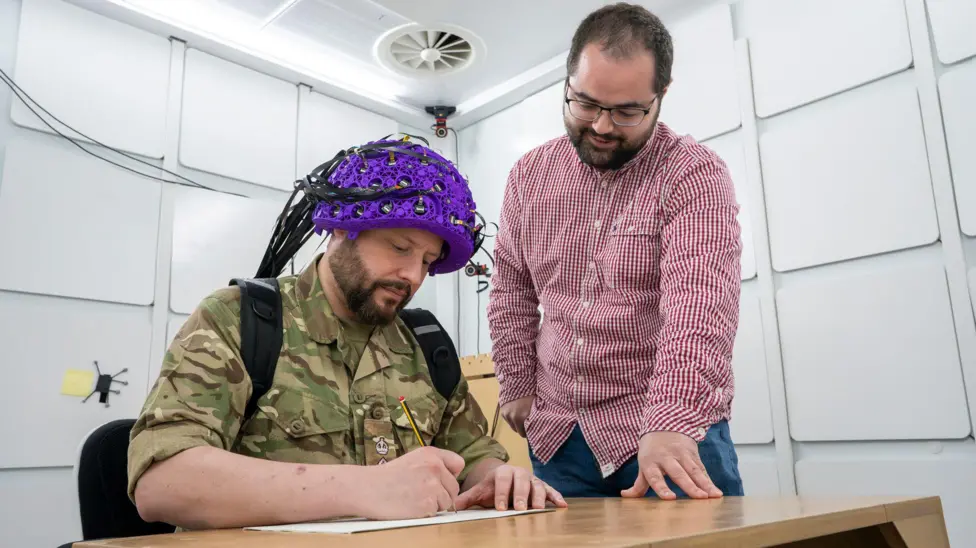
A world-first mobile brain scanner capable of measuring the immediate effects of blast exposure on military personnel is being developed for use across training sites and operational environments, the Ministry of Defence has announced.
The device, a fully mobile magnetoencephalography (MEG) scanner, will allow researchers to observe changes in brain function within minutes of a blast and track how personnel recover in the hours that follow. The technology aims to close a long-standing gap in understanding how repeated exposure to shock waves from weapons affects long-term brain health.
More than £3 million in MOD funding has been provided for the project, which draws on a decade of UK research in quantum-based brain imaging. The system will be built by Cerca Magnetics, a University of Nottingham spin-out, and used by Defence Medical Services in collaboration with scientists from the Universities of Nottingham and Birmingham.
 |
Get weekly jobs and transition advice. Unsubscribe anytime. |
Taking advanced neuroscience into the field
Unlike conventional scanners, which are confined to laboratories and hospitals, the new MEG system will be deployed directly to firing ranges, field hospitals and rehabilitation centres. Researchers say this will make it possible to capture effects that are subtle, short-lived and previously impossible to measure.
Defence Minister Louise Sandher-Jones MP said the technology would “provide crucial insights that weren’t possible before”, improving how personnel are protected. She also noted that the research could benefit wider fields such as dementia, epilepsy and concussion.
Lt Col James Mitchell, consultant neurologist and chief investigator for the UK Military Blast Study, said the system would be “transformative”, giving Defence its first accurate, time-stamped picture of how the brain responds to blast over the minutes and hours after exposure.
Addressing a critical knowledge gap
Repeated exposure to shock waves may lead to subtle changes in brain function that accumulate across a career, potentially increasing the risk of neurological conditions. However, safe exposure limits are not known because the effects dissipate rapidly—often within 24 to 48 hours—and cannot be captured using static hospital-based scanning.
The mobile MEG system is designed to perform rapid scans on-site, allowing clinicians to assess any changes and inform return-to-duty decisions. Researchers will study multiple weapon types and recovery patterns to identify who may be most at risk and what safe exposure thresholds should look like.
Quantum technology leading the way
Professor Matthew Brookes, who has led development of OPM-MEG technology, said the shift from static to mobile systems could “revolutionise” brain imaging well beyond Defence, with potential use at hospitals, sports venues and emergency settings.
Professor Karen Mullinger, co-leading the research programme, said the technology’s precision made it ideally suited to detecting the acute neural effects of blast exposure.
The scanner’s development is supported by the UK National Quantum Technologies Programme, with construction involving UK and US partners including Magnetic Shields Limited, QuSpin and the University of Nottingham School of Physics. The system is expected to be operational by March 2026.